Purdue’s PUR-1 research reactor. (Photo: Purdue University)
The remote, automatic, real-time adjustment of a research reactor’s power by a geographically distributed control system has been reported by researchers from Idaho National Laboratory, the Grainger College of Engineering at the University of Illinois–Urbana-Champaign, and Purdue University. The investigators first used an automatic adjustment “digital control loop” system to demonstrate remote adjustments of Purdue’s PUR-1 research reactor. They then applied a reinforcement learning model that simulates the interaction of physical forces inside the reactor, making the loop system more autonomous.
Purdue president Mung Chiang, left, and BWXT senior vice president and chief corporate affairs officer Suzy Sterner display their signed agreement on collaboration. (Photo: BWXT)
BWX Technologies and Purdue University have signed a memorandum of understanding to collaborate on research focused on next-generation nuclear technologies, including small modular reactors and microreactors.
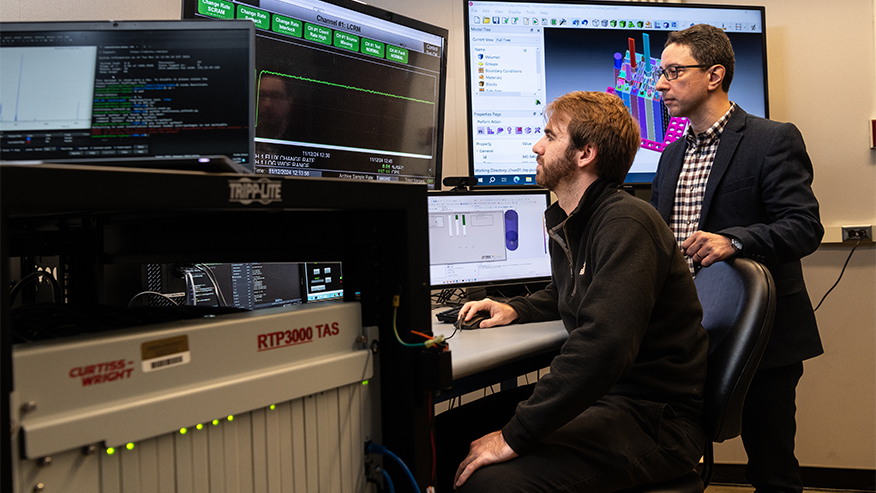
A digital twin of Purdue’s reactor appears on monitors in Stylianos Chatzidakis’s lab. Chatzidakis observes PhD student Zach Dahm, seated, as he toggles through different views. (Purdue University photo/John Underwood)
A research reactor built in 1962 that was converted to digital control and operation in 2019 is aiding the development of advanced nuclear reactors, such as small modular reactors and microreactors. An article published by Purdue University describes how Purdue University Reactor Number One (PUR-1), currently the only facility to be licensed for a fully digital safety and control system by the Nuclear Regulatory Commission, is being used to perform “first-of-a-kind experiments that are unique to the nuclear sector.”
Purdue University, in West Lafayette, Ind.
Purdue University and Duke Energy have announced that they plan to jointly explore the feasibility of using advanced nuclear energy to meet the university’s long-term energy needs, “a move that may be unprecedented for a college campus.” A small modular reactor could meet the current and future needs for Purdue’s West Lafayette, Ind., campus, as well as provide excess power to the state’s electric grid, according to a joint press release.









 Research into the high-resolution detection of plutonium mixtures by Purdue University professor Rusi Taleyarkhan and his team was featured on the cover of the February issue of the Journal of Analytical Atomic Spectroscopy, published by the British Royal Society of Chemistry.